Showing posts with label writer. Show all posts

Friday, October 2, 2015

How to Leverage Your Personality to Bolster Your Writing Productivity

 
I recently attended a religious woman's retreat and during one of our sessions, we discussed our personality types. The Myers-Briggs test from the '50s is a wonderful way to figure out your strengths and weaknesses, what type of career would play out your natural gifts, and may other facets of life. As I explored a topic I've already studied in the past, I realized that the dry spell I've been having in my fictional writing might be due to the fact that I wasn't playing up the needs of my personality.


Re-discovering What Makes Me Feel Accomplished

I haven't changed a bit. That is to say, I've become great at adapting to life's curve balls, but I'm the same person I was ten, fifteen, even twenty years ago. We all are unique, with quirks and needs that affect every part of our world. We have things that make us tick, that make us happy or content or even giddy. Those things can be leverage to make us productive and overflow with inspiration simply by being true to who we are and what works best for us.

Unfortunately, in the last few months, my inspiration well has been drier than a grain of Sahara sand at high noon. Focusing was impossible, words stopped up somewhere between brain and fingers, and I'm fairly certain intelligence chipped off and escaped my body. Lazy, bored, uninspired, and frustrated, I sat in front of a blank screen and stared, mentally begging the words to come.

Turns out, I'd been so wrapped up in life that I'd forgotten a fundamental part of who I am. Specifically, where I got my energy.

One of four parts of a personality according to the test I mentioned above is about how you recharge, how you gather yourself back to being okay. Do you need to be surrounded by people and socializing to feel whole, or do you prefer the quiet solitude to think and imagine?

I am an extrovert. The months I've spent cooped up in our rental, trudging through life in a infuriatingly silence were literally leaving me exhausted and empty. With a simple day retreat with other woman and a 20 point questionnaire, I realized my writing life won't ever be fulfilling if I don't let my need of people, of recharging with many others surrounding me, to be a regular part of it.

Additionally, the final element in my personality made me realize it may be time to take advantage of structure. A schedule, follow through, and completing small goals might help me feel more accomplished. I might even need to be a *gulp* plotter though I've proudly been a pantser for years. Perhaps the plotting will help me focus and complete projects.

I've taken a hold of these bits of myself and developed a plan that I hope will lead my writing in a forward motion. It may require creating my own real-life writing group since I can't find one. It may mean that I need to go to a bookstore or library to write instead of holing up in my office at home. You can do make your own plan once you know your personality type and examined your current habits against it.


Types and Tendencies

If you've never checked out what your personality is, even if you are very self aware, I'd highly recommend it. Insights such as this may help you develop a writing, plotting, or marketing campaign that works better for you than your current one. Keep in mind, some people take on roles or tendencies outside of their true personality, but this is about what is most comfortable or natural to you. Feel free to fill out this "knock-off" personality test (the Myers-Briggs one costs some money) that you can use to get a better sense of your strengths and weaknesses so you can leverage them for your writing.


The four categories used to analyze your personality are:

  • Extrovert/Introvert - Do you get your energy recharge from group settings and the energy of others or from quiet time alone in personal or spiritual activities? 
    • Regular in person critique groups will appeal to extraverts, while secluded or quiet writing time might appeal to introverts.


  • Sensing/ Intuit - How do you take in information? Do you rely strictly on facts of the world around you or do you follow gut instincts?
    • This can affect your research style or help you analyze critiques to better your manuscripts.
  • Thinker/Feeler - Do you use logic or your feelings to process things?
    • Thinkers may be more willing to ask questions of beta readers or feedback, while a feeler may need to take some time to process before replying.
  • Judging/ Perceiving - How to you use the information and how important is structure in your life? Do you need a regular, scheduled routine or is spontaneity important to your process?
    • The good ol' pantser/plotter come into play here. Do you need more structure than you realized previously? Deadlines are important to Judgers, while perceivers may consider deadlines flexible.


By knowing the way you best handle these elements, you can bend your writing time and process to better accommodate your writing.

Click to Tweet: "E.G. Moore discusses how your personality should affect your writing habits on @YAtopia_blog"

I'd love to know what you discovered! Please share your personality type and any ah-ha moments you may have had when you read about it in the comments below. Pinterest is also a great place to find out more about your type one you discover it. Just enter your four letter combination into the search bar, and have some fun.


E. G. Moore is a poet, freelance writer, and storyteller (the first of which her mom still has recorded on a cassette tape.)  She is a long distance member of For Pete’s Sake Writers Group in Washington, active in an email writer’s response group, and a Rocky Mountain Chapter SCBWI member. When she’s not telling “Mommy Made stories” to her two daughters or nagging her husband to edit her latest manuscript, she can be found off-roading in her suped-up ATV, baking some scrumptious bread, or in a long, plot-refreshing bubble bath. She’s represented by Jessica Schmeidler of Golden Wheat Literary. E.G. Moore tweets, posts on Facebook, and blogs at: www.emilygmoorewriter.blogspot.com

Wednesday, September 2, 2015

How Writers' Self-Doubt can Bleed into Other Areas of Your Life and How to Stop It

Let's talk about Self-Doubt. 

You know the monster. All writers (artists really) have battled it when it rears its fowl head. It's so unpredictable and devastating. One minute you're cruising along, fingers flying across the keyboard, and the next you're curled into a ball, slurping ice cream with a straw, and wondering if your words are worth anything. It's normal (or is it just me?).

What isn't normal is letting that self-doubt seep like a poisonous tea into other waters of your life. I've struggled to maintain control like so many others. Yet I've had this crippling issue move its way into my parenting, my spiritual sphere, and my other relationships. How do we damn it up? How do we curb it in the first place?

What it comes down to is tripping up the thoughts that build up self-doubt and then resisting the pull to stay there.

Get Some Support

Surrounding yourself with people either going through the same thing or enthusiastic about you and your writing will lessen self-doubt and keep it at bay. Getting involved in a local writers group, plugging into online support through twitter, facebook groups, or other blogs with feedback and encouragement are all great examples. Even taking writing breaks or chatting with a non-writer friend about your self doubt and being affirmed can help.

Think Happy Thoughts

Coping mechanisms for non-writers can work for writing self doubt as well. Do things you love between drafting or edits will keep you from being hard on yourself. Reread parts of your manuscript that you love, such as snappy dialog or beautiful imagery. Chances are if you love it, your critique partner/agent/publisher/fans will too. Even a few good laughs, time with pets or loved ones, or cute cat pictures on Facebook will do in a pinch.

Don't Rely on "If Only"

It's easy to do the "if only" mind process and try to focus on how you'll be better at things if you only had an agent, a book deal, etc... but the truth is even the most successful author deals with whether what they have written is worthy of their fans. Just because a writer has an agent or has published a book doesn't mean they are free from uncertainty.

Things to Remember

When I'm being rough on myself, these are what I try to remind myself:
  • Every writer feels like this once in a while
  • I will be successful if I keep at it
  • No one can tell my story like I can
  • I really want someone to read my work
  • I'm writing because I love it
  • I can do this! 
Every one of these statements is true for every writer, so use them over and over. Stop self doubt so you can meet your writing goals and enjoy every moment.

What are you're stragedy for dealing with self doubt? Please tell us in the comments!

---

E. G. Moore is a poet, freelance writer, and storyteller (the first of which her mom still has recorded on a cassette tape.)  She is a long distance member of For Pete’s Sake Writers Group in Washington, active in an email writer’s response group, and a Rocky Mountain Chapter SCBWI member. When she’s not telling “Mommy Made stories” to her two daughters or nagging her husband to edit her latest manuscript, she can be found off-roading in her suped-up ATV, baking some scrumptious bread, or in a long, plot-refreshing bubble bath. She’s represented by Jessica Schmeidler of Golden Wheat Literary. E.G. Moore tweets, posts on Facebook, and blogs at: www.emilygmoorewriter.blogspot.com


Wednesday, August 26, 2015

GUESTOPIA! Interview with Candice Lemon-Scott

It is with great pleasure I bring a very special author interview straight from the Gold Coast today. Please join me in welcoming Candice Lemon-Scott to Guestopia!

Click for Options

Hi Candice! Thank you so much for joining us!
 
 
Is this your first published book?

No, I had several standalone chapter books published before the Jake in Space books, as well as a school reader. I’ve also published a novel for adults, Unloched, which received a commendation in the Victorian Premier’s Awards for an unpublished manuscript before it was picked up by Odyssey Books.

Which genre?

Science Fiction.

Which age group?

7-11.

Is it a series or standalone? 

Click for OptionsIt’s a six-book series.

Are you an agented author?

No, I don’t have an agent.

Which publisher snapped up your book?

New Frontier Publishing.

Do you have another job?

Yes, I own a bookstore on the Gold Coast, Big B Books.

Did you receive many, if any, rejections prior?

I received two rejections before New Frontier Publishing picked up the first book and asked me to create a series from it.
 
What created/what were you doing or watching when the first idea for this book sneaked up on you?

I have no idea how I ended up writing a science fiction adventure. It just evolved that way from my memory of failing my driving test numerous times (I won’t tell you how many, it’s way too embarrassing). As such, I had to learn a lot about space and the science of space travel to write this series. It’s been an exciting learning curve.

How long did you plot/plan until you started writing it?

I don’t really plan my stories out so I just started writing about this boy, Jake, who kept failing his driving test and was sent to remedial space car driving school on the Moon. The adventure developed from there. I quickly discovered I needed to learn some stuff about the Moon to write this story when he got there though so it took about a month to do all the research so I could write the book.

Once you started, did the story flow naturally or did you have to step in and wrestle it into submission?

Because there’s a mystery element involved I did have to wrestle with the story a bit so that the pieces of information were revealed at the right time and made logical sense, as much as you can in a futuristic setting where kids learn to drive space cars and use slooper goo.

How many drafts did you write before you let someone read it? Who was that someone?

Usually I only write my first draft before I read my work to my husband, and sometimes my kids if it’s appropriate for their age. Reading aloud is my process of beginning the editing process because it’s then I notice anything that needs attention, such as where the story isn’t working as it should, if there are any issues with flow and plausibility and of course picking up any poor spelling and grammar or word repetition.

How many drafts until it was published?

I did about 3-4 drafts myself, then another three with the publisher, plus a final proofread.

Has the book changed dramatically since the first draft?

The story itself hasn’t changed much but the writing style has. I originally wrote it in first person, present tense until my editor suggested I rewrite it in third person, past tense. It works much better in the new form. Oh, and Jake wasn’t called Jake originally.

Are there any parts you’d like to change even now?

Click for OptionsNo, it’s gone through enough edits and I’m now completely happy with it, phew!

What part of writing do you find the easiest?

Writing the initial story – that’s the fun part.

What part do you find hardest?

Fixing anything that’s implausible – especially when it comes to science fiction.

Do you push through writing barriers or walk away?

Push through them usually, unless it’s a problem with the overall story. If I didn’t do that I’d give up and never get anything finished.

How many projects do you have on the go at the same time?

Usually only one, or two at most. I like to concentrate all my creative energy on one project at a time once I know what story I want to tell.

Do you think you’re born with the talent to write or do you think it can be learned?

I think it’s a combination of both, like with anything. For me, I was always an avid reader and keen writer. English was my favourite subject at school and teachers often read my stories to the class. I later went on to study writing and editing though through my Bachelor of Communication/Diploma of Arts (Professional Writing & Editing) so I learned to refine and improve my writing skills then. I’m always learning to become a better writer even now too and, like everything, writing gets better with practise.

How many future novels do you have planned?

Lots! I have so many ideas that I just need the time and patience to write them.

Do you write other things, such as short stories, articles, blogs, etc?

I published several parenting articles and had a regular blog spot when my children were little. I also have a media background so I’ve written a gazillion news reports.

What’s the highlight of being published so far?
 
Having Jake in Space: Moon Attack listed in the Herald Sun ’12 Books Children Will Love in Christmas 2014.’

 Give me five writing tips that work for you.

1.       I must have a great character with a massive problem to deal with.

2.       I need to get inside the head of my main character and write as though I am that person.

3.       My ideas come when I get active and have a clear mind to allow the story to appear, not from sitting in front of a computer screen.

4.       I need to have a story outcome in mind as a guide but I don’t need to stick to it if things take a different direction.

5.       I have to enjoy the writing – if it’s a constant struggle, the story isn’t there yet so I need to take a break and rethink it or let it go.

And one that doesn't.

Not caring about the main character and what happens to him or her – if I don’t care, no one else will either.

Can you give us a clue or secret about the next book?

My YA novel Clearwing just received a highly commended place at the CYA Conference so I’m hoping to develop that further now.


Thank you so much, Candice! Good luck with Clearwing!

Go out an buy Jake in Space, YAtopians, it's a fantastic series for lower middle grade readers, I promise you won't be disappointed.

If you want to know more about Ms Lemon-Scott and follow the progress of her new projects, check out these links below.

Website
Facebook
Twitter
LinkedIn

And even Jake has his own website!


Thursday, February 12, 2015

YA's PG-13 Misconception

The other day I was listening to the audio book of Kendare Blake's ANNA DRESSED IN BLOOD. Within the first two chapters I heard the "F" bomb. Twice.

It was wonderful.

But I found myself double-checking that the book was indeed a YA. For the record, it is Young Adult. And shame on me for thinking just because a book has a certain four-letter word it suddenly becomes Adult.

YA is not the literary equivalent of a PG-13 movie. This is something I had a misconception of. Young Adult fiction is defined that way simply because the perspective of the narrative and main characters is that of an adolescent. That's it.

It would be ignorant to assume teenagers don't swear. It would also be naive to think some don't occasionally smoke, drink, have sex, take illicit drugs, make mistakes, have an opinion.

They are human aren't they?

The wonderful thing about literature over film is that there isn't too much of a box to be cramped by. Each of our experiences with a book, while shared in regards to the plot, is completely unique for every one of us.

Whether it's the fantastically grotesque aftermath of a monster attack in Rick Yancey's THE MONSTRUMOLOGIST or the aforementioned Kendare Blake novel, YA doesn't mean authors should back down from the way they intend to tell their stories. Even though it's all lies in the end, truth resonates still. Readers expect as much. Readers deserve as much.

Sean


Monday, January 26, 2015

Guestopia! Interview with NA author E.L. Wicker

This month, I invited a very special author I've had the pleasure of working with, the beautiful and talented NA writer E.L. Wicker, to join us on YAtopia and tell us about her debut book, Fractured Immortal.

Hi Emma! Thanks so much for letting me interview you. Let's get to it!


Are you self published or traditional?
I self-published.

Is this your first published book?
First!

What’s it called?
Fractured Immortal

Which genre?
Paranormal Romance

Which age group?
New Adult

Is it a series or standalone?
Series

Do you have another job?
Paid job – No. But I do a vast range of things for other writers from Beta reading (which I suck at because, before you know it, I’ve got the red pen in my hand and I’m into full blown critique mode), free promotion, free formatting, free blog tour design and I have some really great critique partners.

Did you receive many, if any, rejections prior to publication?
I only queried one agent and it was a very early draft. My cheeks go pink thinking about it. The manuscript was in terrible shape and I had no business querying. Lesson learned. It takes many, many drafts to make a book!

What were you doing or watching when the first idea for this book sneaked up on you?
I was listening to ‘Let Her Go’ by Passenger and all these images started popping into my head. One image or ‘scene’ in particular and actually the only scene that made it into the book – the moment where Ilia meets Nathaniel for the first time. I felt that I needed to write the story around that scene. A few months later, Fractured Immortal was born.

How long did you plot/plan until you started writing it?
As I mentioned above, I pictured that scene and it took me a while before I realized that it wasn’t going to go away. It intrigued me and I started thinking – where can I go from here? About two months later, I began creating the characters. From there it became a case of write, write, write. There are many scenes that didn’t make it into the book. I think if I put the complete book with the outtakes, the book would double in size. I am a true pantser so if something didn’t work when I’d written it, it got chopped.

When you started, did the story flow naturally or did you have to step in and wrestle it into submission?
I am a linear writer. From chapter one all the way to the end, I keep it going. Sometimes I have to stop and cut a chapter here or there because it wasn’t right or the chapter was really just a scene that needed no more than a couple of paragraphs. I battled furiously with a particular character throughout the process, but in the end, he shaped up better than I imagined him.

How long did the first draft take to write?
From October 2013 to April 2014. From there I spent nearly every waking hour rewriting, cutting, adding and polishing. In late May / early June, I thought it was complete. I thought wrong! In August 2014 my critique partners ripped their way through it and more chapters got deleted. From there another Beta reader (who is a lot like me and goes all CP on it) went through it for the first time. She did the same again prior to release to make sure it was perfect. When it was finally ready, it went to an editor and more changes were made, though they were small and involved tightening some of my language and weeding out repetitive phrases.

How many drafts did you write before you let someone read it? Who was that someone?
Honestly, I don’t know how many drafts but I can tell you with certainty that when I did unleash it, it wasn’t ready. My first Beta reader was Nori, aka ReadWriteLove28. She provided great feedback, all of which I actioned. I feel sorry for her that she had to read such an early version. Writing is a learning process, I learned a lot!

Did you employ an editor/proofreader or did you have critique partners/beta readers?
I used all of the above. I have a beta reader list the length of my arm and my critique partners, Kathleen Palm and Natasha Raulerson were excellent. Then, off it went to my editor, Kate Foster (me!) who did a terrific job honing and polishing it. Then it went back to Nancy Griffis, the most in depth Beta reader I have ever had the pleasure of working with.

Roughly how many drafts did it take before you felt ready to publish?
Far too many to count. I think my laptop is close to exploding with the amount of files I have. I have this habit of never deleting a draft, just in case.

Has the book changed dramatically since the first draft?
Yes. The first draft contained multiple POV’s. A total nightmarish mess. Lucas, Kyle, Nathaniel and Ilia all had their own chapters as well as 3rd Omniscient flashbacks to 1810, a prologue with the antagonists POV and some other rubbish stuff!

Are there any parts you’d like to change even now?
I could have messed with Fractured Immortal for eternity but there comes a time where you have to say, that’s it – that’s the story, if you meddle anymore, you’re going to break something.

What part of writing do you find the easiest?
The dialogue between Kyle and Ilia, it flowed quite naturally and the battle scenes, which I thought would be the hardest. They weren’t easy, as such, but they were very enjoyable to write.

What part do you find hardest?
Nailing the backstory was so difficult. I knew what happened, but trying to express it without dumping it on the reader, I found that really tough.

Do you push through writing barriers or walk away?
I have a mini-fit, tell myself I can’t possibly do it, I’m totally rubbish and what on Earth was I thinking when I decided to write a book. Then I spend a while ignoring the book, maybe write a blog post or listen to music, then I get back at it. I push through the barriers eventually, but that sometimes requires walking away for a brief period.

How many projects do you have on the go at the same time?
I prefer to have only one project on the go at a time but right now, I have two, which is driving me batty.

Do you think you’re born with the talent to write or do you think it can be learned?
That’s a tough one to answer. My family are mostly artists, my sisters and my daughters can literally bring things to life on canvas, but me, I fail at drawing even the simplest of things. It became evident early in my life that I was a bookworm and writing began as soon as I could put pen to paper and structure, albeit very badly, my own scenes. The brain is a wonderful thing and a scientific study showed how, in seasoned writers, a part of the brain called the caudate nucleus becomes very active when writing. The study compared novice writers against experienced ones, that part of the novices' brains remained pretty much dormant. But can you teach that part of your brain to become active? I’m afraid I lack the qualifications to say.

How many future novels do you have planned?
I have three planned but I have another idea floating around inside my head, developing itself. I know I’m going to end up writing it because its got that same persistence about it that Fractured Immortal had.

Do you write other things, such as short stories, articles, blogs, etc?
I write blogs, I also like writing lyrics.

What’s the highlight of being published so far?
The biggest highlight so far is logging onto Twitter and one of my friends had retweeted a tweet she’d seen about my book. I was over the moon, serious happy tears.

Give YAtopia five writing tips that work for you.
When you can’t seem to form the words, listen to music to get the creative juices flowing. This works for me.
Listen. If the same thing is being flagged by different people over and over, then you have a problem so listen to what your beta readers / critique partners / editors are saying and revise.
Another listen. If your brain is nagging at you that something isn’t quite right, try to work through it before pressing on. I recently ended up ditching 40-50k words because my brain kept telling me something was off. When I found what it was, I had to rewrite because it was something that took my story in the wrong direction. I could’ve saved myself a lot of work and time had I listened.
First drafts are just that, first drafts. Don’t think your first draft of your MS is the final draft, it rarely – if ever – is. Keep at that first draft until you have a shiny manuscript.
Lastly, when you’re feeling a bit rubbish and you think you can’t do it, know this – yes you can. You just have to take a breath, regroup your thoughts and then get back at it. You CAN do it.

And one that doesn’t.
Write what you know. Poppycock. If I wrote what I knew, I’d have a story about a dog that puffs heinous smelling air from his butt and an evil cat that pasted part of my manuscript on Facebook –  as my status. And while that might sound mildly amusing, I can’t write a book about smelly farts and a cat that walks across the keyboard. Well, maybe I can, but I would have to build a plot around it and they would be minor parts of the story. I don’t know how to write a mystery or a thriller, I don’t know how to write for middle grade but I also didn’t know how to write New Adult. In one of the manuscripts I’m working on now, I had to thoroughly research DNA. I knew nothing of DNA before I started writing and now I do. Write what you know, pfff. If you don’t know it – learn it. James Patterson was not a policeman, Andrew Gross was not a policeman, either, or a hedgefund manager and Enid Blyton didn’t have a magic tree in her backyard or was J.K. Rowling a pupil at Hogwarts. If it’s not real, imagine it, if it is real, research it.

Can you give us a clue or secret about the next book?
A regular character will die and it breaks my heart, but it’s key to the development of another character.

What question have you always wanted to be asked but never have? What would the answer be?
Why a book about vampires? Because I wanted to. I had neither read nor watched Twilight when I began Fractured Immortal and it’s gets on my nerves when I see people tweeting rubbish things like ‘tired of seeing vampire books – read mine, guaranteed no vampires’ – (actual tweet or close enough) –oh, get a grip. Don’t bash one genre to try and sell another. It’s not cool and I will send my dog to expel air in close proximity to your nasal passages.

Thank you so much for joining us, Emma, we wish you so much luck with Fractured Immortal. 

If you haven't read Emma's awesome book, then here are the links to purchase! Trust me, it's worth it and this is truly an author to look out for. 


amazon.co.uk 


amazon.com


Goodreads

Sunday, January 11, 2015

Publishing is a House with Many Doors


You don't need an agent.

But, Sean! you say. Aren't you always spouting advice about how to query and interact with agents?! Now you're telling me not to even bother?!

Go back to my first sentence. I said you don't need one. You can certainly want one. I do. It's a personal preference. Agents do a great many things you probably already know about.

But let's face facts. Sometimes agents might not think your manuscript is sellable in the market at that time. Should you trunk the novel? If you want to. However, allow me to offer another option.

While many big publishers require an agent to be the contact point between author and editor, there are many amazing publishing houses that accept unagented submissions. Tor is one that comes to mind, which is great for peeps like me who write speculative fiction.

That's right, kids. You can basically be your own agent.

Many, many, many authors did the reverse of what is thought to be the standard way to get published.

Brandon Sanderson met his editor at a convention and was offered publication. Then he went looking for an agent. His Writing Excuses co-host, Dan Wells, did the same thing.

And let's not forget smaller publishers. Sure, there are a lot of crap ones out there that slap their books with a stock photo and some cheesy font, and whose website looks like it was designed by your seven-year-old niece. But there are tons of amazing independent publishers that do some stellar work and whose books sit on the same Barnes and Noble shelves with Random House, William Morrow and the rest.

If you want an agent first, that's great! Do it. If you exhaust that, but still think your book is sellable and ready to rock, don't shy away from submitting to willing editors.

Just because one door closes, doesn't mean you should mope away down the street. Publishing is a house with many doors, and one will open for you if you just keep knocking.


Wednesday, November 12, 2014

The No Spark Rejection


If you're a writer and any kind of good, you'll inevitably get past form rejections and make it to the big leagues of actual comments on your work.

Wow. An agent/editor was moved enough to give a personalized rejection!

But this can be bitter sweet.

Sometimes they might offer helpful feedback that, if you agree with it, can help you fix an area of your manuscript you and your CPs hadn't caught. Heck, they might even request a rewrite.

Other times it's not so helpful.

The "no spark" rejection, also known as the "didn't connect" or "just didn't love it the way I wanted to" rejection, is a big, acrid jug of "no thanks".

And there's nothing you can do about it. Often these rejections are attached with comments saying there's nothing wrong with your work. Not one dang thing! You have great characters, an interesting premise, the pacing is right, there are no cliches--but....

It's a case of "she's just not that into you".

These kinds of rejections can be hard to take. "But you said there's nothing wrong with it!" As productive human beings we struggle with the thought that there is nothing to fix. No flick of the wand that'll brush things up for the next agent/editor.

But on the flip side of things, you don't have to fix anything. Move on to the next agent. Send the work out to the next editor. Just like dating, you can't get bent out of shape over one person, even if you thought you guys would be great together and you really just "knew" it was going to happen.

I've thought about this over the last month in great detail. And I've thought of books I have on my shelf that I didn't really like.

Pet Semetary - Meh. Didn't think it was that scary, just really sad. It made me hug my one-year-old son tighter every day, but I didn't feel that "spark".

The Name of the Wind - I picked it up thinking the hordes of people praising it couldn't be wrong. But they were, at least, in comparison to what I like. It wasn't a bad book. It just wasn't that great. I had higher hopes for it.

Divergent, The Hunger Games, and a good many other YA books - They were written in present tense. I disdain present tense, and that's putting it gently. Not that it means the books are bad. They just don't fit into my wheel of cool.

And this is just my opinion, my taste. I am but one individual and there are plenty others with differing views. It's the same with the people you submit to. They're people--fallible, unique.

But that's what makes this journey we've endeavored to begin so magical. It might take you a few tries at the arcane table. You might have to send more than one raven with your potion of awesome.

It's hard. But that doesn't mean it's not worth it.

-- Sean


Sunday, October 12, 2014

Rejection: A Hard Look at a Tough Reality

The other day I biked to work. It was a grueling seven mile ride made even more difficult because all I have is a mountain bike and the surrounding area wouldn't be what you'd call cyclist-friendly.

On my way home I came to a mental crossroads. I was berated by the voice of some lazy, tired part of me to stop. "Enough with the biking already. These hills are killing me!"

At that point I was about four miles away from my house--less than half of the trek completed. What were my choices? Was stopping and looking like a schlub on the side of the road an option? Would I walk my bike the rest of the way and have the little free-time I get wasted because I decided to go for a slower option?

No. What I did was ignore that stupid voice and pressed on.

I knew that it would be difficult, yes, but the reward at the end was greater than the temporary relief of stopping. I knew that if I kept going, my muscles would be made stronger. My next trip would be easier because my anatomy and my spirit would have been primed for it. I knew the only way to get better was to keep going.

Now, let's talk writing.

Every author whose books fill bookstore shelves has faced, received, and been pummeled by rejection. Rejection is one of those things that is talked about in the writing community as a necessary evil and a "thems the breaks, kid" brushing off of the shoulder.

But that doesn't mean it doesn't sting. It doesn't mean that it's easy to take.

But if this gig was easy, everyone would be doing it.

Some authors are more vocal about their early struggles than others and I'm sure it's easy to forget the battle of first starting out, or we might not fully realize or appreciate that all these big wig writers have been said no to.

I can't speak for self-publishing, but let's look at the traditional route.

Some people may say, "Huzzah! I've got an agent. Life has now been made easy."

Oh, boy.

Well, congrats on getting representation, but don't forget that now that agent has to submit to editors and rejection is still a very real possibility. If this was a video game: You've finally found someone who has agreed to let you into the dungeon, but you've got a long road until the boss battle. And then you have to win.

So, you've gotten an editor who loves your manuscript. Again, hooray for you! But that editor, more than likely, has to take it to a meeting of people who make the decision of what their publishing house will be printing that year. Your work now has to impress at least a majority of those at this gathering.

You're going to be published!. Hip hop hooray. Now, I'm sure this is a wonderful feeling that no one can take away from you. But, again, rejection is a very real thing. If your book doesn't sell well enough in the eyes of the publisher, they might not take another chance on you. And then you basically have to go back to Level 1. I know that no one plans on this happening and, if you and the agent and the editor have busted tail to make the book the best it can be, it's out of your hands.

But rejection is still real.

Your book and your writing career are in the readers' hands. This is a fact that applies to both traditional and self-published endeavors.

So, Sean, what's the point? I mean, with all this rejection why should I even try?

I remember when I told a family member I wanted to become a fireman. They said pretty much the same thing. "A lot of people go out for that job. It's hard to get in."

Two months ago marked four years of me being a professional firefighter.

Just because something is hard, does it mean it's not worth the pursuit?

I believe it makes it that much more cherished and wonderful when you finally do succeed.

Rejection gives you tough skin, a badge of honor in your attempt. It weeds out those who didn't want it bad enough. It strengthens those that press on. Being told no should build up the appreciation of the inevitable yes.

And it is inevitable.

I firmly believe that those who never give up learn a vast amount more than those who never start. With that hard-earned knowledge, you become better. You find new ways of telling stories and try things that no one else can.

You become a professional.

I am not here to tell you that rejection becomes easier. It absolutely doesn't go away. What I'm saying is that, like burs on a cotton plant, like a hangover from too much fun, it goes with the territory. And those that want to live on these crazy, hard-toil plains have to learn to accept it.


- Sean


P.S.

Sean's Hydra Querying Technique

Remember the tale of Hercules and the Hydra and how every time he whacked off one head, two would grow in its place? Here's a trick that can help you during the rough days logged in the query trenches.

1. Query an initial set of agents. Most people say 10.

2. If you get a rejection, query two more agents in place of that one who passed.

This promotes momentum and helps you cast a big net. Please, still do your research and make sure the intended agents rep your kind of manuscript.


Tuesday, August 12, 2014

Writing Hacks During the Revision Process

You've heard of life hacks--simple tricks that make your life easier, more fun, and interesting.

While every book is different and you have no doubt found your own bag of editing swag, some tools are just indispensable.

I'm in the middle of revision right now. And starting another novel. This may or may not be ill-advised, but I'll see how it went after I'm done.

Here are some writing hacks that you may or may not have heard of.

1. Paragraph Hacking

You don't have to read the following. Just look at each section and tell me which looks more inviting to the eyes.

Example 1

We hold these truths to be self-evident, that all men are created equal, that they are endowed by their Creator with certain unalienable Rights, that among these are Life, Liberty and the pursuit of Happiness. — That to secure these rights, Governments are instituted among Men, deriving their just powers from the consent of the governed, — That whenever any Form of Government becomes destructive of these ends, it is the Right of the People to alter or to abolish it, and to institute new Government, laying its foundation on such principles and organizing its powers in such form, as to them shall seem most likely to effect their Safety and Happiness. Prudence, indeed, will dictate that Governments long established should not be changed for light and transient causes; and accordingly all experience hath shewn that mankind are more disposed to suffer, while evils are sufferable than to right themselves by abolishing the forms to which they are accustomed. But when a long train of abuses and usurpations, pursuing invariably the same Object evinces a design to reduce them under absolute Despotism, it is their right, it is their duty, to throw off such Government, and to provide new Guards for their future security. — Such has been the patient sufferance of these Colonies; and such is now the necessity which constrains them to alter their former Systems of Government. The history of the present King of Great Britain is a history of repeated injuries and usurpations, all having in direct object the establishment of an absolute Tyranny over these States. To prove this, let Facts be submitted to a candid world.

Example 2

We hold these truths to be self-evident, that all men are created equal, that they are endowed by their Creator with certain unalienable Rights, that among these are Life, Liberty and the pursuit of Happiness.

That to secure these rights, Governments are instituted among Men, deriving their just powers from the consent of the governed, — That whenever any Form of Government becomes destructive of these ends, it is the Right of the People to alter or to abolish it, and to institute new Government, laying its foundation on such principles and organizing its powers in such form, as to them shall seem most likely to effect their Safety and Happiness.

Prudence, indeed, will dictate that Governments long established should not be changed for light and transient causes; and accordingly all experience hath shewn that mankind are more disposed to suffer, while evils are sufferable than to right themselves by abolishing the forms to which they are accustomed.

But when a long train of abuses and usurpations, pursuing invariably the same Object evinces a design to reduce them under absolute Despotism, it is their right, it is their duty, to throw off such Government, and to provide new Guards for their future security.

Such has been the patient sufferance of these Colonies; and such is now the necessity which constrains them to alter their former Systems of Government.

The history of the present King of Great Britain is a history of repeated injuries and usurpations, all having in direct object the establishment of an absolute Tyranny over these States. To prove this, let Facts be submitted to a candid world.


Both examples are an excerpt from the Declaration of Independence, penned by Thomas Jefferson. But only one is structured in a welcoming way.

The second example is the winner. The reader doesn't go, "Oh, great let me slog through this."

Don't be afraid to break up your paragraphs.

Even if they are only a sentence long, a single sentence paragraph is a great technique to get a particularly important message to the reader.

(See what I did there?)

2. Reading Aloud

Yeah, yeah. You've heard this before.

But it works.

While going through your manuscript during edits, read aloud. If you stumble on a word or sentence or it just seems weird to you, investigate the conundrum and see if it needs to be added to, cut, or changed to make it all flow better.


3. Get Feedback but Wait on Using it.

Run through your manuscript by yourself the first time and then consult your beta readers' notes. You may fix something they point out any way.

You want constructive critique but you don't want any notes that could adversely shift the structure of your story.

Remember, YOU are the architect. The CPs are the guys who make sure your building is up to code and not a fire hazard.

You want to have the deepest sense of your story FIRST, then look at the notes and see how it fits in the large scheme.


Revision is different for everybody and no one has all the answers. At the end of the day, it's your book and your call. Do what works for you.

But at least DO revise. First drafts are toothpick houses built by the tide. They have to be moved, fortified, and made to last.

And you're the one with the plan.


Thursday, July 24, 2014

8 Things I Know About Being a Writer

Yesterday, I deposited my first ever advance check and it got me thinking about my journey up to this point. I've been seriously pursuing my writing for about five and half years now. I've been a newbie, an intern, a "publishing professional," a blogger, a vlogger - and now I'm a paid author. It's a weird place. Some see me as an "expert" and others still see me as a newbie. Some people seek out my advice and others dismiss it.

But here are some things I know for sure about this crazy process of trying to become an author:

1) You will doubt yourself.

Whether it's about which publishing path you're pursuing, or wondering if you should completely throw in the towel because you might not be cut out for it, or making a specific decision about a specific element of your work, you will doubt yourself.

The only thing you can do is know what you want and know what you're willing to go through to get it. Stop when you cross that line, but not before.

2) Not everyone is on your side.

There are jealous, petty, egotistical people out there, even in our wonderful industry. There are people who think there's not enough room in the industry for both of you to be successful. This is, of course, bullshit. Please don't waste your time or emotions on these people.


On the professional side, there are scam artists out there looking to take advantage of eager, unwitting writers. There are even those who mean well who simply don't have the experience and knowledge necessary to do what they promise. Educate yourself.

3) Not everyone is out to see you fail.

In fact, there are thousands of people in the industry willing to share their knowledge, to cheer you on, to encourage and inspire you. There are agents who want to help writers have successful careers. There are editors who want to see their authors' books hit bestseller lists. There are bloggers who will be your fans before your book even comes out. There are self-publishing advocates who truly want to help authors take this path. There are industry professionals who write blogs and answer writers' questions in their spare time when they are not being paid for it.

4) You will never know everything.

You can't. You have to accept this right now. "Type-A"s, I'm talking to you.


5) You need to know everything.

And it never stops. When you're writing, you need to learn as much about the craft as possible. It also doesn't hurt to know the market. When you're querying, you need to know which agents/editors are picking up what you're putting down and and you need to figure out how to convince them to read your work. If you self-publish, there is an infinite list of things you need to know about. And when you've published? That's where the real fun begins. Because creative types are generally not natural marketers and, to top it all off....

6) Nobody knows why some books go mega-blockbuster and others languish in the remainder bin.

If they tell you they know, they're trying to sell you something. There are a lot of guesses. There are even some guesses that turn out to be true. There are some things publishers can do to try to tip the scales, but they sometimes fail spectacularly anyway. Sometimes, a book that's thrown up on amazon with a cover slapped together in Paint hits the NYT.

The initial print run on Harry Potter was 500 books. Authors can get upper six figure advances for books you'll never hear about.


7) There is a good chance you will "fail."

Even if you learn everything. Even if you bust your ass and sacrifice dutifully. Even if you're an incredible writer. Even if you do everything right.

Your commercial publishing goals may not come true. But...

8) It's all worth it.

No matter what happens, there is nothing in the world like writing.

“We write to taste life twice, in the moment and in retrospect.”
― Anaïs Nin

“You must stay drunk on writing so reality cannot destroy you.”
― Ray Bradbury, Zen in the Art of Writing

“Tomorrow may be hell, but today was a good writing day, and on the good writing days nothing else matters.”
― Neil Gaiman

“let me live, love, and say it well in good sentences”
― Sylvia Plath

“I write to give myself strength. I write to be the characters that I am not. I write to explore all the things I'm afraid of. ”
― Joss Whedon

“A word after a word after a word is power.”
― Margaret Atwood

Saturday, June 28, 2014

How To Format A Manuscript To Publishing Industry Standards

Hello, lovely YAtopians!!! 

Why yes, I am in a good mood and that's because I'm kicking it on the beach this week. In honor of vacation, I've decided to recycle an oldie, but a goodie- a blog post I wrote some time back about how to format a manuscript- since I'm still seeing a lot of manuscripts in my freelance editing that are, well, a bit funky in terms of formatting. 

Is standardized formatting a deal-breaker? Of course not. But getting it right does show you've taken the time to research the industry and THAT says a lot about you to an agent or editor. 

Here’s how to format so you look like a seasoned pro who has done your homework!
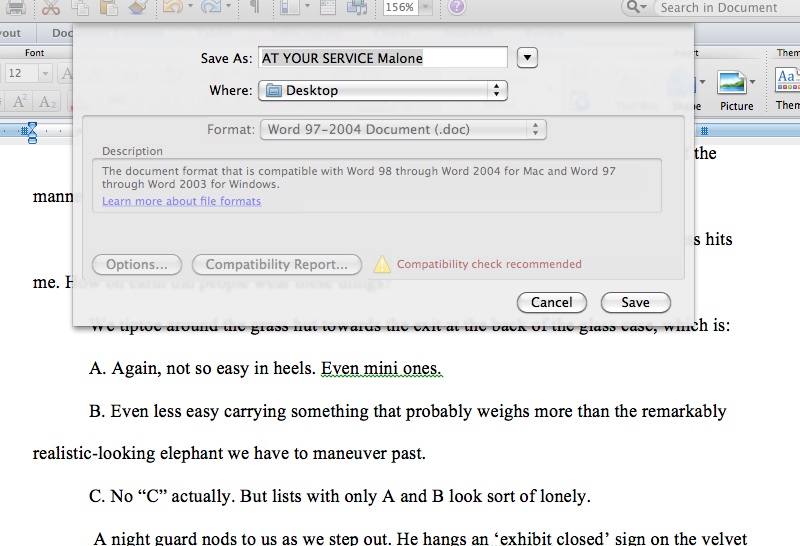
First things first. Your manuscript should be saved as “TITLE Last Name” so that it’s easily searchable when an agent needs to locate it on his/her Kindle/e-reader.  The title should be in all caps and your last name does not need to be. You could also indicate “partial” or “full” in the document name if that applies. Please, please, do not label “TITLE version 4768” or “TITLE draft 2013”. You may have been polishing your ms for years, but I’m not sure you want to share that information at this point in the process. If you are using Microsoft Word, save the file as a .doc as opposed to .docx as not all agents can open the newer docx format.
saing document
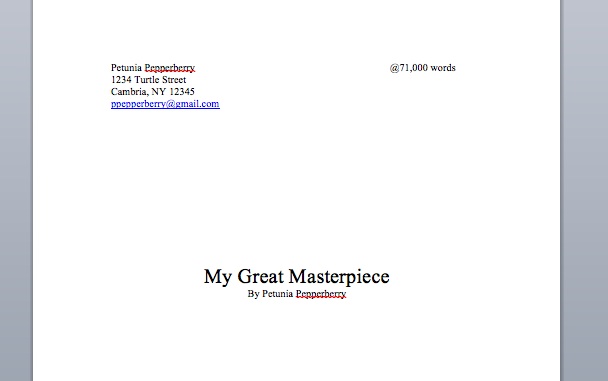
Next, your document should begin with a cover sheet that looks like the picture below.  For the sake of your career, take five minutes and set up a professionally-named email account to use so that your cover sheet does not include MomofTwelve@crazytown.com or “Shmoopylovecakes@glitter.com. The bottom half of this sheet will be blank. A final note on this: round your word count up or down to the nearest 1,000.
cover sheet
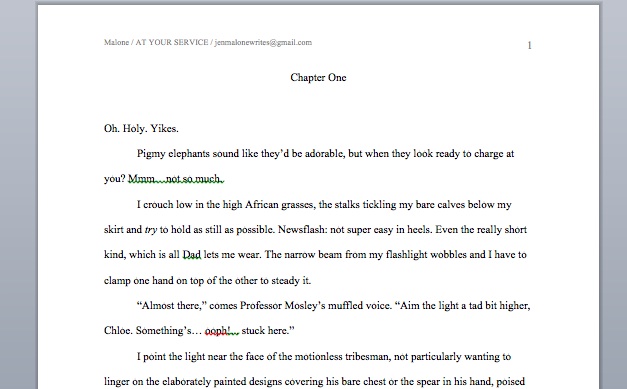
The next page is where your manuscript begins. First things first, include a header on every page for agents who like to print out submissions, so if the pages get swept up in a windstorm the agent will instantly know who wrote this brilliant thing they’re reading and how to put it back in order!  Include your title, name, and contact information in the header. You should also include page numbers in the opposite top corner or on the bottom of each page.
You do not need to format your manuscript to look like a printed book (I actually did this–complete with cover art–when I sent my ms to my very first reader and she very politely and with a straight face, suggested I, um, reformat ASAP!) This is not yet a book, it is a manuscript, so there is no need to drop your chapter beginnings to mid-page or include photos you envision enlivening your text (If it helps you feel like you’ve written a novel versus a term paper, by all means save a copy like this that you can revel in! But send the agents the one that looks like a boring dissertation and let your words do the impressing instead.)
It should look something like this:
page one
Note above that I used a standard font (Times New Roman and Courier are the two most requested by agents) and size (12-point) for all text (you can go to 24-point for the title on your cover page but otherwise 12, 12, 12!  All text should be double-spaced..
Next, go grab a published book off your shelf.
Trust me on this.
Open to the first page of any chapter and peek at the first line. It’s not indented. I know, I KNOW. You never noticed this before, in all your years of reading. Your mind is blown! But it’s true: The first sentence of chapter openings and of scene breaks are NOT indented. If you follow my instructions below, you will be formatting your text to automatically indent each paragraph so this is something you’ll need to fix manually when you’re done writing.
Speaking of indenting.  You’ll want to format your ms so that you do not hit the tab bar even once in the document. You also do not want to hit the space bar five times with each new paragraph. But why, Jen? It all looks the same on the page. Yes. Yes, it does. But, fates willing, when this sells in a giant multi-book deal it won’t to the person at the big, fancy publishing house formatting your manuscript into a book. And, more importantly at this stage, it won’t on an ereader, where it is extremely likely your book will be read by a requesting agent.
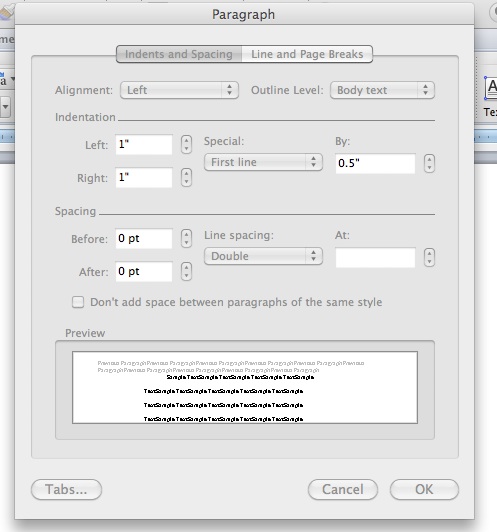
Instead (for Microsoft Word), along the top menu bar, go to Format and select Paragraph. Then fill out the form as follows with regard to margins, spacing, and indentation. This will set up your document so that when you hit the return key, the cursor will automatically indent five spaces for the start of the new paragraph.
paragraph formating
You know how I mentioned above not hitting that space bar five times? You also don’t want to hit it twice. If you’re anything like me, you learned there were two spaces between sentences. Not no more! Now there is only one. If you can train yourself to write this way, you are golden. if you’re like me and just can’t get your brain to compute when you’re busy typing alllllll the words as fast as they form in your head, you can fix this at the very end. You’ll want to do a “Find and Replace”. Where you would ordinarily type a word for your computer to search for, you’re going to hit the space bar twice. Then go to the next line (replace) and hit the space bar once. Then hit enter. I would show you a pretty picture of this, but, well, it’s all kind of invisible. But it does work, I promise!
At the end of each chapter, select “Insert Page Break” from the Insert section along the top menu bar, rather than hitting return until you reach a blank page. As you revise, this will preserve your chapter breaks for you.
Finally, after the very last line of your ms, center a row of several ##### signs to let the reader know they’ve reached THE END!
On that note:
#########

Thursday, June 12, 2014

Going Hermit: Getting Away from All the Noise


Not too long ago I decided to take a break from Twitter. It wasn't a long hiatus and, granted, the big dent punched into my mobile data was a significant motivation toward that decision, but all that aside--I needed to remove the distraction. And coming back, I wish I would have taken a longer walk away from it all.

Sometimes I forget that Twitter and other forms of social media are not solely mediums to mingle with other writers, to promote your work, or to stalk the agents who have your MS.

It can drive you nuts.

And soon you find you're doing more "Tweet gazing" than working on your work in progress or plotting or revising or editing. (What's the difference between those last two again?)

It's not just the interwebs either. You can be surrounded, if not completely pummeled, by family and work obligations. Sometimes it's like you can't breathe with all the noise noise NOISE!


That's why I advocate going hermit every so often.

You read correctly. We are all familiar with the image of the loner, bohemian writer, locked away in solitude, drinking absinthe and struggling over every last consonant and punctuation.


You don't have to go that far.

There are many writing retreats you can pay for or, even better, you can get with local writing buddies and sock away an entire weekend with no phones, no internet, just writing and companionship. And sleep for God's sake.

Rent a hotel room. Go to the library to write. At minimum, hit that disconnect from WiFi button on your laptop and dive into the world you are creating.

It's easy to get sucked up in the world of publishing and who's pitching what and what one idiot said online about the genre you love to read.

So easy, in fact, that you can neglect the one thing that makes a writer a writer.

Writing.


Sean