Showing posts with label self-publishing. Show all posts

Tuesday, May 24, 2016

Hard Truth Time: Not Every Book Deserves to be Published

I wrote this book. Let's call it MF. I thought it was fantastic, unique, clever, wonderful, etc. It was going to be a great hit and sell movies because it was so awesome.

It was the second book I ever wrote (the first is this glorious kind of mess that I do intend on resurrecting one day) and I thought I had figured out this book-writing thing. Friends told me it was great. When I saw hundreds of agent rejections, those same friends said things like, "Have you thought about self-publishing? I heard about this author who makes so much money doing that."

This was in that weird transitional period of self publishing where some industry people were just starting to admit its validity as a publishing option.

But I knew self-publishing was not right for that book. As green as I was, I knew how hard it was (and is) for self-published authors to sell books in the YA market. After querying it ad nauseam, I put it aside and started writing another book (which would become Dragons are People, Too).

While in the querying trenches for DAPT, I decided to go back to MF and see if I could repackage it or edit it again -- do something with it.

Dear Lady Godiva, was that book terrible:

  • Derivative with serious pacing issues. 
  • A sagging middle on a scale of geologic proportions.
  • Unlikable characters at every turn. 
  • Absolutely no sense of place. 
  • A magic system that makes zero sense.


With distance and a year+ of education and study, I could see the book clearly. I felt a little embarrassed that I had sent this to so many agents; that so many people I respected had actually had to read part of it. If I were to salvage it, it would require a complete start-over-from-page-one rewrite.

I'm writing this now because I see the "if this gets x many rejections, I'm just going to self publish it" conversation nearly every day now. While I fully support self-publishing (my romance alter-ego Aria Kane self-publishes most of her books), I don't think it's for everyone or every book and I do believe too many people go into it without enough research or knowledge. As with almost everything else in life: Just because you can, doesn't necessarily mean you should.

I understand this supportive culture we've developed in this industry and I love it. Publishing is a tough gig. We all need cheerleaders sometimes. But I am so glad I didn't have today's resounding chorus of "Yeah! Just self-publish it!" back then. I might have listened to them and I would have regretted it.

Because, honestly, some books just don't deserve to be published. Some books, like MF, suck big-time. And the most important part is:

that's okay! 

It doesn't mean you're a bad writer. It doesn't mean you won't ever write a great book. It is not a judgement on your worth or your value.

It's a tough truth to face. I know how hard it is to let go of a book that you've spent a year or more working on. It seems like letting go of those characters and that story will kill you or, less dramatically, that you may never write another book you love just as much.

But you will. And the next one will probably be better.

A closing note: I can't tell you how you know whether a book is worth it or not. I struggle with that, myself. But I do know that spending time away from the book can give you enough distance to make that self-evaluation. Or find a critical someone who is really not afraid to break your heart.

Saturday, March 12, 2016

Traversing the Trilogy - Where it all began

Over the next few months, I'm going to talk about what led up to my decision to self-publish The Domino Project trilogy. With the whole thing out there now, I'm going to reflect back on its road, and the things I learned.

The road to my decision

Way back in June 2011 I realized pantsing books wasn't working for me. I'm a very organized person, and really, should have known all along that I needed to be a plotter. After some research and adapting questions I found online, I ended up plotting out The Domino Project. Very loosely. After a couple of days, I had a long and detailed plot outline for Chameleon. Then I proceeded to draft out books two and three.

 That was my first mistake, but I'll come back to that a bit later.

At the end of 2011, with a complete trilogy under my belt, I began editing Chameleon (during NaNo I believe). By February 2012 I was mostly done with edits, and a few friends convinced me to enter Operation Awesome, and the very first PitchMadness.

I did - and had a ninja agent request from Operation Awesome, and two agents who wanted my full in PitchMadness... which evolved into an offer from one of them. Chameleon hooked my first agent for me.

Needless to say, I love this book. But it was only ever subbed out to five editors, and when my first agent left the business, my second agent wouldn't read it. I just don't think it was high on her priority list - after all, she didn't sign me with it. A lot of things happened that led me to the decision to put Chameleon out there myself.

In total I went through: 

  • Two agents 
  • Four submitted books 
  • Approximately 55 failed editor submissions 
  • With about 20 no responses 
  • But two of the responses got REALLY close 
  • One R&R that due to circumstances never got to me 
  • And about 20 of those 35 responses said my genre was bad market timing. 


Bad market timing has been my nemesis for years now. I do not write to market, and I don't know how to. I write the stories I would like to read, and hope they coincide, but my luck just isn't there and that's okay. I get it.

Chameleon is a labor of love. It changed a lot from its inception to the final draft. Of which there were about twelve. Which - and now I'll come back to it - means that books two and three sort of had to be mostly rewritten, and entirely reworked. Probably better to have done a round or two of edits before you draft that second book... Avoids a lot of labor later on.

Fun Fact: The Domino Project is not my baby. I adore it and the characters like a mom, but it's not my baby. That's a different book, one I hope to share with people in a year or so.

To summarize:
I wrote the books, I put in the effort. I've edited, been in the query trenches, been in submission hell and wracked up rejections.

I didn't want to wait another 5-10 years and hope that Chameleon's genre came back into the light, and then hope that an agent and an editor loved it. So, I bit the bullet, went over the manuscript with a fine tooth comb again, had all the books content and copy edited, professional covers and layouting done, and decided to put it out there myself.

And I'm damn proud of the books.

I'll go over the following things in the coming months:

  • Drafting & Editing
  • The Announcement and your todo list
  • Choosing editors (content and copy)
  • Finding a Cover artist and interior formatter
  • The pros and cons of Kindle Unlimited
  • The indie-stigma that permeates everything you do
  • And different angles to take on marketing
  • Perks and happy things!


Monday, January 26, 2015

Guestopia! Interview with NA author E.L. Wicker

This month, I invited a very special author I've had the pleasure of working with, the beautiful and talented NA writer E.L. Wicker, to join us on YAtopia and tell us about her debut book, Fractured Immortal.

Hi Emma! Thanks so much for letting me interview you. Let's get to it!


Are you self published or traditional?
I self-published.

Is this your first published book?
First!

What’s it called?
Fractured Immortal

Which genre?
Paranormal Romance

Which age group?
New Adult

Is it a series or standalone?
Series

Do you have another job?
Paid job – No. But I do a vast range of things for other writers from Beta reading (which I suck at because, before you know it, I’ve got the red pen in my hand and I’m into full blown critique mode), free promotion, free formatting, free blog tour design and I have some really great critique partners.

Did you receive many, if any, rejections prior to publication?
I only queried one agent and it was a very early draft. My cheeks go pink thinking about it. The manuscript was in terrible shape and I had no business querying. Lesson learned. It takes many, many drafts to make a book!

What were you doing or watching when the first idea for this book sneaked up on you?
I was listening to ‘Let Her Go’ by Passenger and all these images started popping into my head. One image or ‘scene’ in particular and actually the only scene that made it into the book – the moment where Ilia meets Nathaniel for the first time. I felt that I needed to write the story around that scene. A few months later, Fractured Immortal was born.

How long did you plot/plan until you started writing it?
As I mentioned above, I pictured that scene and it took me a while before I realized that it wasn’t going to go away. It intrigued me and I started thinking – where can I go from here? About two months later, I began creating the characters. From there it became a case of write, write, write. There are many scenes that didn’t make it into the book. I think if I put the complete book with the outtakes, the book would double in size. I am a true pantser so if something didn’t work when I’d written it, it got chopped.

When you started, did the story flow naturally or did you have to step in and wrestle it into submission?
I am a linear writer. From chapter one all the way to the end, I keep it going. Sometimes I have to stop and cut a chapter here or there because it wasn’t right or the chapter was really just a scene that needed no more than a couple of paragraphs. I battled furiously with a particular character throughout the process, but in the end, he shaped up better than I imagined him.

How long did the first draft take to write?
From October 2013 to April 2014. From there I spent nearly every waking hour rewriting, cutting, adding and polishing. In late May / early June, I thought it was complete. I thought wrong! In August 2014 my critique partners ripped their way through it and more chapters got deleted. From there another Beta reader (who is a lot like me and goes all CP on it) went through it for the first time. She did the same again prior to release to make sure it was perfect. When it was finally ready, it went to an editor and more changes were made, though they were small and involved tightening some of my language and weeding out repetitive phrases.

How many drafts did you write before you let someone read it? Who was that someone?
Honestly, I don’t know how many drafts but I can tell you with certainty that when I did unleash it, it wasn’t ready. My first Beta reader was Nori, aka ReadWriteLove28. She provided great feedback, all of which I actioned. I feel sorry for her that she had to read such an early version. Writing is a learning process, I learned a lot!

Did you employ an editor/proofreader or did you have critique partners/beta readers?
I used all of the above. I have a beta reader list the length of my arm and my critique partners, Kathleen Palm and Natasha Raulerson were excellent. Then, off it went to my editor, Kate Foster (me!) who did a terrific job honing and polishing it. Then it went back to Nancy Griffis, the most in depth Beta reader I have ever had the pleasure of working with.

Roughly how many drafts did it take before you felt ready to publish?
Far too many to count. I think my laptop is close to exploding with the amount of files I have. I have this habit of never deleting a draft, just in case.

Has the book changed dramatically since the first draft?
Yes. The first draft contained multiple POV’s. A total nightmarish mess. Lucas, Kyle, Nathaniel and Ilia all had their own chapters as well as 3rd Omniscient flashbacks to 1810, a prologue with the antagonists POV and some other rubbish stuff!

Are there any parts you’d like to change even now?
I could have messed with Fractured Immortal for eternity but there comes a time where you have to say, that’s it – that’s the story, if you meddle anymore, you’re going to break something.

What part of writing do you find the easiest?
The dialogue between Kyle and Ilia, it flowed quite naturally and the battle scenes, which I thought would be the hardest. They weren’t easy, as such, but they were very enjoyable to write.

What part do you find hardest?
Nailing the backstory was so difficult. I knew what happened, but trying to express it without dumping it on the reader, I found that really tough.

Do you push through writing barriers or walk away?
I have a mini-fit, tell myself I can’t possibly do it, I’m totally rubbish and what on Earth was I thinking when I decided to write a book. Then I spend a while ignoring the book, maybe write a blog post or listen to music, then I get back at it. I push through the barriers eventually, but that sometimes requires walking away for a brief period.

How many projects do you have on the go at the same time?
I prefer to have only one project on the go at a time but right now, I have two, which is driving me batty.

Do you think you’re born with the talent to write or do you think it can be learned?
That’s a tough one to answer. My family are mostly artists, my sisters and my daughters can literally bring things to life on canvas, but me, I fail at drawing even the simplest of things. It became evident early in my life that I was a bookworm and writing began as soon as I could put pen to paper and structure, albeit very badly, my own scenes. The brain is a wonderful thing and a scientific study showed how, in seasoned writers, a part of the brain called the caudate nucleus becomes very active when writing. The study compared novice writers against experienced ones, that part of the novices' brains remained pretty much dormant. But can you teach that part of your brain to become active? I’m afraid I lack the qualifications to say.

How many future novels do you have planned?
I have three planned but I have another idea floating around inside my head, developing itself. I know I’m going to end up writing it because its got that same persistence about it that Fractured Immortal had.

Do you write other things, such as short stories, articles, blogs, etc?
I write blogs, I also like writing lyrics.

What’s the highlight of being published so far?
The biggest highlight so far is logging onto Twitter and one of my friends had retweeted a tweet she’d seen about my book. I was over the moon, serious happy tears.

Give YAtopia five writing tips that work for you.
When you can’t seem to form the words, listen to music to get the creative juices flowing. This works for me.
Listen. If the same thing is being flagged by different people over and over, then you have a problem so listen to what your beta readers / critique partners / editors are saying and revise.
Another listen. If your brain is nagging at you that something isn’t quite right, try to work through it before pressing on. I recently ended up ditching 40-50k words because my brain kept telling me something was off. When I found what it was, I had to rewrite because it was something that took my story in the wrong direction. I could’ve saved myself a lot of work and time had I listened.
First drafts are just that, first drafts. Don’t think your first draft of your MS is the final draft, it rarely – if ever – is. Keep at that first draft until you have a shiny manuscript.
Lastly, when you’re feeling a bit rubbish and you think you can’t do it, know this – yes you can. You just have to take a breath, regroup your thoughts and then get back at it. You CAN do it.

And one that doesn’t.
Write what you know. Poppycock. If I wrote what I knew, I’d have a story about a dog that puffs heinous smelling air from his butt and an evil cat that pasted part of my manuscript on Facebook –  as my status. And while that might sound mildly amusing, I can’t write a book about smelly farts and a cat that walks across the keyboard. Well, maybe I can, but I would have to build a plot around it and they would be minor parts of the story. I don’t know how to write a mystery or a thriller, I don’t know how to write for middle grade but I also didn’t know how to write New Adult. In one of the manuscripts I’m working on now, I had to thoroughly research DNA. I knew nothing of DNA before I started writing and now I do. Write what you know, pfff. If you don’t know it – learn it. James Patterson was not a policeman, Andrew Gross was not a policeman, either, or a hedgefund manager and Enid Blyton didn’t have a magic tree in her backyard or was J.K. Rowling a pupil at Hogwarts. If it’s not real, imagine it, if it is real, research it.

Can you give us a clue or secret about the next book?
A regular character will die and it breaks my heart, but it’s key to the development of another character.

What question have you always wanted to be asked but never have? What would the answer be?
Why a book about vampires? Because I wanted to. I had neither read nor watched Twilight when I began Fractured Immortal and it’s gets on my nerves when I see people tweeting rubbish things like ‘tired of seeing vampire books – read mine, guaranteed no vampires’ – (actual tweet or close enough) –oh, get a grip. Don’t bash one genre to try and sell another. It’s not cool and I will send my dog to expel air in close proximity to your nasal passages.

Thank you so much for joining us, Emma, we wish you so much luck with Fractured Immortal. 

If you haven't read Emma's awesome book, then here are the links to purchase! Trust me, it's worth it and this is truly an author to look out for. 


amazon.co.uk 


amazon.com


Goodreads

Friday, October 10, 2014

Traditional vs Self Published Books

As the world of publishing grows, evolves and mutates, the net is cast ever wider on the methods of publication open to writers - self publishing, traditional, indie, hybrid. There are lots of opinions on the matter of whether this new direction of publishing is a good thing or not, and the debate has raged on many sides of the argument.

Some say that the traditional mode of publishing is stuffy and constricting, that it limits authors' productivity and creativity, and that it gives an author less control over their own work. Others argue that it upholds a certain standard, gets professional eyes on a book to make it the very best it can be, and knows how to handle the market.

Others argue that self publishing gives an author freedom and full control of their books and allows them to publish on a schedule that suits them.

Indie authors love the closeness they have with their publishing team and how connected they are at every step of the process...and some say that the lack of marketing and publisher reach can be an issue.

Yet more go for a hybrid mix of the two, taking what they need from each avenue. Still more think that becoming hybrid can lead to inconsistency within their "brand".

So, YATopians...what do you think?  Is there a perfect publishing route for a writer? Tell us here!

** Also, on the flip side - for anyone who'd like to, there is a poll over at Debate It asking whether you prefer to read books traditionally, self, hybrid, or indie published. Feel free to come over and join us.


Saturday, June 28, 2014

How To Format A Manuscript To Publishing Industry Standards

Hello, lovely YAtopians!!! 

Why yes, I am in a good mood and that's because I'm kicking it on the beach this week. In honor of vacation, I've decided to recycle an oldie, but a goodie- a blog post I wrote some time back about how to format a manuscript- since I'm still seeing a lot of manuscripts in my freelance editing that are, well, a bit funky in terms of formatting. 

Is standardized formatting a deal-breaker? Of course not. But getting it right does show you've taken the time to research the industry and THAT says a lot about you to an agent or editor. 

Here’s how to format so you look like a seasoned pro who has done your homework!
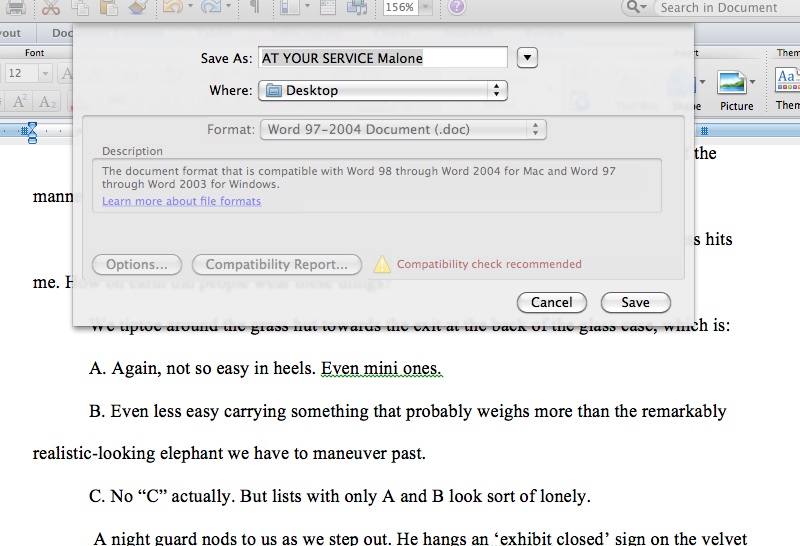
First things first. Your manuscript should be saved as “TITLE Last Name” so that it’s easily searchable when an agent needs to locate it on his/her Kindle/e-reader.  The title should be in all caps and your last name does not need to be. You could also indicate “partial” or “full” in the document name if that applies. Please, please, do not label “TITLE version 4768” or “TITLE draft 2013”. You may have been polishing your ms for years, but I’m not sure you want to share that information at this point in the process. If you are using Microsoft Word, save the file as a .doc as opposed to .docx as not all agents can open the newer docx format.
saing document
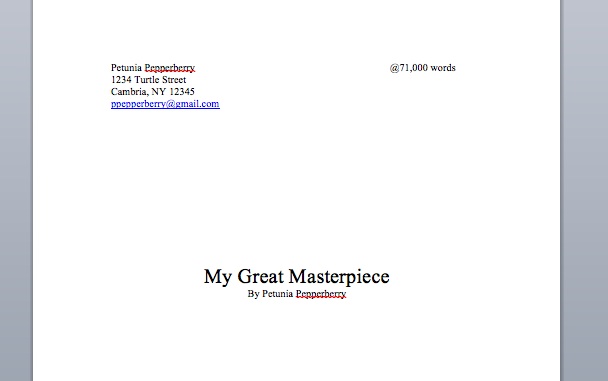
Next, your document should begin with a cover sheet that looks like the picture below.  For the sake of your career, take five minutes and set up a professionally-named email account to use so that your cover sheet does not include MomofTwelve@crazytown.com or “Shmoopylovecakes@glitter.com. The bottom half of this sheet will be blank. A final note on this: round your word count up or down to the nearest 1,000.
cover sheet
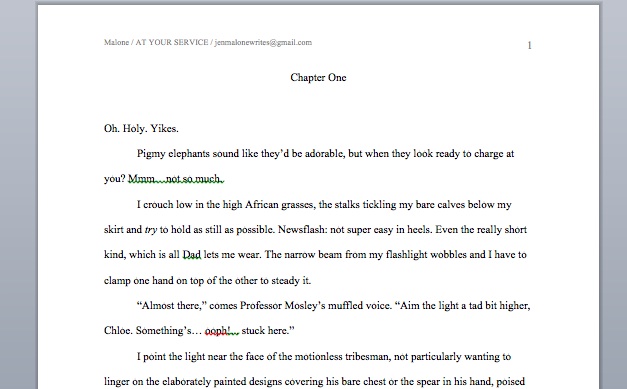
The next page is where your manuscript begins. First things first, include a header on every page for agents who like to print out submissions, so if the pages get swept up in a windstorm the agent will instantly know who wrote this brilliant thing they’re reading and how to put it back in order!  Include your title, name, and contact information in the header. You should also include page numbers in the opposite top corner or on the bottom of each page.
You do not need to format your manuscript to look like a printed book (I actually did this–complete with cover art–when I sent my ms to my very first reader and she very politely and with a straight face, suggested I, um, reformat ASAP!) This is not yet a book, it is a manuscript, so there is no need to drop your chapter beginnings to mid-page or include photos you envision enlivening your text (If it helps you feel like you’ve written a novel versus a term paper, by all means save a copy like this that you can revel in! But send the agents the one that looks like a boring dissertation and let your words do the impressing instead.)
It should look something like this:
page one
Note above that I used a standard font (Times New Roman and Courier are the two most requested by agents) and size (12-point) for all text (you can go to 24-point for the title on your cover page but otherwise 12, 12, 12!  All text should be double-spaced..
Next, go grab a published book off your shelf.
Trust me on this.
Open to the first page of any chapter and peek at the first line. It’s not indented. I know, I KNOW. You never noticed this before, in all your years of reading. Your mind is blown! But it’s true: The first sentence of chapter openings and of scene breaks are NOT indented. If you follow my instructions below, you will be formatting your text to automatically indent each paragraph so this is something you’ll need to fix manually when you’re done writing.
Speaking of indenting.  You’ll want to format your ms so that you do not hit the tab bar even once in the document. You also do not want to hit the space bar five times with each new paragraph. But why, Jen? It all looks the same on the page. Yes. Yes, it does. But, fates willing, when this sells in a giant multi-book deal it won’t to the person at the big, fancy publishing house formatting your manuscript into a book. And, more importantly at this stage, it won’t on an ereader, where it is extremely likely your book will be read by a requesting agent.
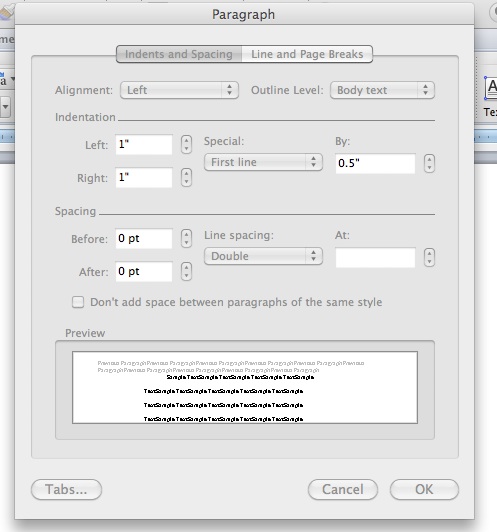
Instead (for Microsoft Word), along the top menu bar, go to Format and select Paragraph. Then fill out the form as follows with regard to margins, spacing, and indentation. This will set up your document so that when you hit the return key, the cursor will automatically indent five spaces for the start of the new paragraph.
paragraph formating
You know how I mentioned above not hitting that space bar five times? You also don’t want to hit it twice. If you’re anything like me, you learned there were two spaces between sentences. Not no more! Now there is only one. If you can train yourself to write this way, you are golden. if you’re like me and just can’t get your brain to compute when you’re busy typing alllllll the words as fast as they form in your head, you can fix this at the very end. You’ll want to do a “Find and Replace”. Where you would ordinarily type a word for your computer to search for, you’re going to hit the space bar twice. Then go to the next line (replace) and hit the space bar once. Then hit enter. I would show you a pretty picture of this, but, well, it’s all kind of invisible. But it does work, I promise!
At the end of each chapter, select “Insert Page Break” from the Insert section along the top menu bar, rather than hitting return until you reach a blank page. As you revise, this will preserve your chapter breaks for you.
Finally, after the very last line of your ms, center a row of several ##### signs to let the reader know they’ve reached THE END!
On that note:
#########

Tuesday, November 20, 2012

New routes to publishing don't mean easier


The face of publishing is changing with writers' communities and self publishing giving authors direct access to readers and giving readers the opportunity to influence what gets into mainstream publishing.

When I first joined Inkpop, I had a feeling it was going to part of something new and exciting. And it was. Leigh Fallon and Wendy Higgins both were discovered via Inkpop.

Wattpad, Figment (who bought Inkpop from HarperCollins) and Movella are sites that I've dabbled on. I'm not overly active on them anymore as my day-job, writing, internship with Entangled and blogging all take priority of these sites. But they can be a lot of fun and a great way to meet writers.

Wattpad has produced Brittany Geragotelis, who had a huge following on the site, self published and then scored a three-book, six-figure deal.

Movella has produced Emily Baker, a member who wrote a One Direction fan fiction that was spotted by Penguin. The publisher then commissioned her to update the story for publication.

We all know Amanda Hocking started in self publishing and then got snavelled up by a publisher.  E.L.James started out with fan fiction that she shared online.

One thing I've noticed with all of these writers is that they all worked really, really hard. Like super hard. On the writing/fan fiction communities you have to work really hard to get readers and develop a following. On Inkpop I had the most popular Australian story, but that involved about 1,000 people reading it. That's nothing compared to Brittany who had 13 million reads.

Amanda Hocking work extremely hard  and she talks about how self publishing isn't easy on her blog. Leigh, Wendy, Brittany and Emily all worked hard on their respective writing sites to gain followers. Site like this can involve a lot of time reading other people's work and giving feedback on it as well as promoting yourself.

Basically, there is no easy path in the publishing industry. You need to write a story people want to read, write it well and then get it out there. It's hard work, but it can be done if you've got the right stuff and are willing to work hard.

So I have some questions for you:

Have you tried any writing community sites that you would recommend?

And if you're interested in getting published, what path are you thinking about taking.

P.S. For those of you looking for an agent, I'm one of the coaches for Pitch Wars and I'm interested in seeing YA and NA pitches.


Wednesday, October 17, 2012

Taking Back Forever Cover Reveal!

My friend Karen Amanda Hooper is a wonderful writer. My other friend Alexandra Shostak is a very talented cover designer. Put them both together and... well, you'll see :-)

...

Karen Amanda Hooper, author of Tangled Tides and Grasping at Eternity, is sharing her newest cover today. The sequel to Grasping at Eternity, book 2 of The Kindrily series, is titled Taking Back Forever.

Karen and her cover designer, Alexandra Shostak, have worked side by side to create the Taking Back Forever cover. After lots of hard work (and a lot of love) here it is…


Want to know more? Here’s a summary of Taking Back Forever.

Forever is worth the fight.

Maryah erased all memory of her past lives, but she couldn’t erase her soul mate Nathan, or his undying love. Now, Maryah and Nathan have a second chance at a future together, but first Maryah must remember the person she used to be and embrace her supernatural gifts—more than one kindrily member’s life depends on it.

Maryah’s power is Harmony’s best hope of finding her kidnapped soul mate, Gregory. But Harmony isn’t big on asking anyone for help, and she’s tired of waiting, so she’s taking matters into her own hands. Heaven help anyone who stands in her way.


To celebrate, Karen and Alexandra are giving away signed paperbacks of Grasping at Eternity. (Signed by Karen AND Alexandra!)

Contest is open internationally!

a Rafflecopter giveaway


Alexandra Shostak is a writer of dark and fantastical things, mostly meant for teenagers. She is a freelance cover designer, and is available to do covers and interior artwork directly for authors. She is also a former Irish dancer, a guitar player, and the person who can get you through the zombie apocalypse without getting bitten.

If you’re especially worried about the zombie apocalypse, you can find her in one of these places:

www.alexandrashostak.com
www.coversbyalexandra.com
www.yaconfidential.com
or on Twitter as @a_shostak


Karen was born and bred in Baltimore, frolicked and froze in Colorado for a couple of years, and is currently sunning and splashing around Florida with her two beloved dogs. She's addicted to coffee, chocolate, and complicated happily-ever-afters. Due to her strong Disney upbringing, she still believes in fairytales and will forever sprinkle magic throughout all of her novels.
www.KarenAmandaHooper.com
Twitter: @karen_hooper

Saturday, June 25, 2011

I Am Indie. Hear Me Roar.

The world of publishing is changing practically every day. We've seen the rise of e-books, self-published authors (okay, really only one so far), and independent publishers. And in my opinion we're starting to see the decline of the traditional publishing methods.

Self-publishing used to be and may still be considered less "reputable" and less "impressive". But more and more writers who self-publish are taking the time and making the effort to put out high quality products, and are experiencing moderate success. I actually briefly thought about self-publishing a book a couple of years ago, and many friends gave me funny looks and hurled negative opinions about that method at me. And I agreed with them, but having read some really great self-published works, my opinion has changed. I've educated myself and have found great books by some great authors. It's kind of like the blogosphere, really. There are a few bad seeds that attract more attention than the good ones, resulting in a bad name.

The next publishing route that is quickly growing is having a book published through a smaller publisher, or also known as an "independent" publisher. I myself am signed with one (Pendrell Publishing) and so is our very own Kelley York (Entangled Publishing). I really think indie publishers have it going on, so to speak. They all seem to have a hands-on approach and allow the authors to have the same involvement. I've learned a lot from being with Pendrell and I wouldn't want it any other way :-D. And I think this personal interaction is what's drawing people in and the amount of involvement an author can have. The bigger houses still play a major role in publishing and are still great companies, but there's something about indie publishing that's taking root and growing.

In my opinion, readers don't really care who publishes a book just as long as the book itself is good. And isn't that all that matters? A good book is a good book, right?

So, what are your thoughts on self-publishing and smaller publishers? Does it matter to you who a book is published by?

Tuesday, April 12, 2011

Self Publishing: Educate yourself, then make a decision

Working on my new project (not much on the site yet, but there will be in the next two weeks) combined with so many agents and editors blogging about the topic recently has got me thinking a lot about self-publishing lately.

(To be clear, I've been thinking about in the general sense, not thinking about it in the I-want-to-do-it sense.)

This picture really doesn't have much to do with my post...


The ease and rise of self-publishing has put our industry in somewhat of an (long, slow) uproar. There are many questions still to be answered: How is the reader supposed to know what's worth their time and money? Is this the beginning of the end for traditional publishing? Is there still value in going the traditional (legacy) route?

And the number one question on many writers' minds: Is self-publishing right for me?

I know our YAtopian readers are all pretty savvy, knowledgeable people so I'm probably preaching to the choir on this one, but I just want to encourage all writers out there to learn about the industry before making this decision.

I spoke to a man a few weekends ago who began telling me about the book he is publishing. He said he decided to self-publish because he wanted to keep all the profit for himself and maintain control over his work. After about two minutes, it became apparent he knew absolutely nothing about the book-publishing industry (e.g. he asked me what a literary agent does). This, in my opinion, is one of the major problems with the prevalence self-publishing: if anyone can do it, anyone will do it.

Though I'm pursuing the traditional route, I'm not against self-publishing as a rule. I think it can be the right decision for a lot of people, depending on individual goals, situations and talents. But I also think it's the wrong decision for many more people who simply don't know any better. I've heard too many heart-breaking stories about self-publishing gone bad.

If you're thinking about self-publishing (or heck, even if you're thinking about pursuing traditional publishing), I'm begging you to learn as much as you can about how the book industry works. Not only will it help you make a decision that shouldn't be made lightly, the knowledge will help protect and guide you once you choose a path.

I know that learning about the industry is hard and sometimes confusing and it takes a lot of time. But you've spent a lot of time working on that manuscript; don't you think it deserves you spending just a little more time to make sure it doesn't die a slow and painful death?

If you're in this boat, here are some resources to help you get started:  (and I'm sure some of our lovely readers will post a few of their favorites in the comments. *hint.hint* )