Showing posts with label Heroes. Show all posts

Monday, August 28, 2017

How and Why to Write an Anti Hero

To wrap up August's theme of heroes, I want to talk anti heroes.

Why should you write an anti hero?

Short answer: Anti heroes are fascinating. Their moral compass definitely doesn't point true North. But even though they break laws and leave destruction in their wake, these dark heroes are on a mission to do the right thing. Even villains are doing the right thing according to their own story, though, right? So what separates an anti hero from a villain? It's all in the way you write them.


My favorite anti hero is a popular one. Walter White from Breaking Bad. He's an excellent example for how to write an anti hero.

1. The anti hero starts off as a good person.

Walter White starts his story as a straight-and-narrow family man, high school chemistry teacher, and on top of that, he works another job at a car wash to provide for his family. There's nothing villainous about this guy. Even when we see him get irritated, he responds with compliance.

Source: gipy.com

2. The anti hero begrudgingly compromises his morals in response to an impossible situation.

Every protagonist should face an impossible situation. The hero will stand their moral ground and find some way through their mess. They'll stick to their morals even if it means losing because above all, they don't want to lose themselves.

The villain will manipulate, destroy, and do whatever they have to do to get what they want as quickly as they want. It doesn't matter to them who gets hurt in the process.

The anti hero will struggle with what to do to overcome the impossible, but in the end, he compromises his morals for the sake of the goal. Walter White finds out he has lung cancer, and that even with his two jobs, he can't come anywhere close to paying for medical treatment without leaving his family in horrible debt. So when he learns how much money meth dealers make, and he finds a former student in the business, he sees a solution to his problem. Make meth and go into business with his former student. Walter isn't happy about this at all, but he justifies his illegal actions by saying he'll only make enough money to pay for his treatment.

Source: giphy.com

3. Amp up the internal struggle. Make it juicy. Blur the lines.

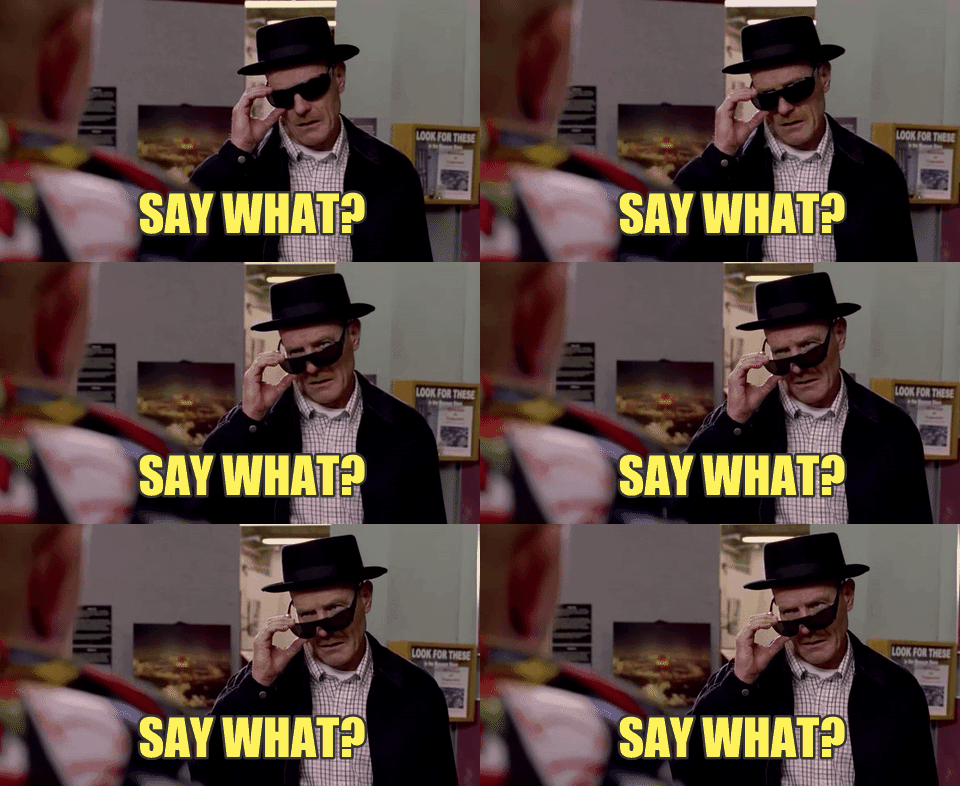
Without giving anything away for those who somehow haven't watched Breaking Bad, there's a scene where Walter White really crosses the morality line, and I mean more than making meth. He crosses the line to right a wrong and make sure his illegal hard work isn't for nothing. And when he crosses that line? Ohhhh, he likes it. He's turned on by it. The dark side of this former straight-and-narrow is unleashed.
Source: giphy.com

4. The anti hero needs to be feared by the right people.

Villains and heroes need to be equally matched so that there's tension and excitement in a fair fight. You'll know you have an anti hero and not a villain when the anti hero opposes a villain and they both fear each other. Walter White went up against rival meth cooks and dealers, even opposing the Cartel. And when he crossed the line to the dark side, he became a force his rivals feared. And here's where things get muddied...there are heroes in the story too: the DA (Walt's brother-in-law). In the eyes of the DA, Walter White (they don't know his identity) is no different or less villainous than the other drug dealers. But remember, Walter sticks to a certain level of morality, and he does it for the sake of his family.

Source: gipy.com

The reason anti villains are so interesting is because no one person is completely good or completely bad. We've all wondered what it would be like to bend or break the law, haven't we? We've wondered what would push us to cross our moral line. Think of the classic scenario of stealing bread to feed your family. The anti hero satisfies that dark side we all have, no matter how tucked away we keep that part of ourselves.

***

Jessie Mullins is married to her highschool sweetheart, and together they have an awesome son. She's a mommy blogger and writes YA. You can find bookish things on her writer Facebook page.

Tuesday, August 22, 2017

My Top Ten YA Heroes / Love Interests


My Top Ten YA Heroes / Love Interests

As our theme this month is heroes, I thought I’d indulge in one of my favourite past times – thinking about fictional men. So, here’s my top ten heroes/love interests from YA. You might notice most of these are from SFF novels, so I apologise for the lack of genre diversity, but it’s the genre of which I read the most. Also, anyone who knows me knows that Snape will forever be my favourite male character invented, so for purposes of giving other characters a chance, I’ve left him off this list.  (Snape, my love – “Always.”)
Let me know if you agree with my list or not in the comments below, and add your own favourites!

10. Raffe - Angelfall - Susan Ee
A personal favourite, Raffe is on his own mission in Angelfall and doesn’t become so completely eclipsed by his love for the main character that he forgets his own agenda. He’s strong but not invincible, and has no objections to Penryn saving him once in a while. Go get them wings, Raffe!

9. Jack – Blood Red Road – Moira Young
Although at first introduction it may seem at first that Jack has popped up to provide the romance element of Blood Red Road, by the end of the novel Moira Young has made it clear Jack has his own path, which doesn’t necessarily follow the same of that of our main character. He resists a system which very possibly could treat him well because of his morals, which is a great hero quality.

8. Peeta – The Hunger Games – Suzanne Collins
Ah Peeta, I still remember falling in love with him for the first time during Hunger Games, and somehow even the thought of him covered in cake icing hiding in a ravine was cute (not so much in the film though eh?) His thoughtful, caring nature was so out of place in that cruel world that he became an unlikely hero. His love for Katniss is a quiet, unassuming love, and doesn’t try to dominate to book. Ten out of ten points for Peeta the perseverer.

7. Jace - The Mortal Instruments - Cassandra Clare
OK, so Jace is typically good looking and with sculpted cheekbones and great mouth, but everyone knows it’s not physical looks which make a hero. Jace has a troubled past and a hard relationship with his father, making him more than just a 2D love interest. He’s powerful, strategic and his wit is as sharp as dem face bones.

6. Simon – Carry On - Rainbow Rowell
Simon is the perfect way to invert the Chosen One trope. All his life he’s been hailed as the hero to save all others, but Simon feels like a failure most of the time. Despite that, and all this unsolicited responsibility heaped at his feet, he keeps going - that makes a true hero to me. Add to that a killer sense of humour and a riveting romance, and Simon more than deserves his place on this list.

5.  Micah – Pantomime – Laura Lam
I don’t want to say too much about Micah in case I give away any spoilers, but they are talented, clever and totally motivated by clear goals. The character development in Pantomime is sublime and really takes the reader alongside the hero’s journey.

4. Otieno – Shadows on the Moon - Zoe Marriott
Shadows on the Moon is one of my favourite books. It shows that heroes and heroines come via all personality types, and don’t have to be unflinchingly brave or with all the right answers and actions. Otieno is not just a loyal, long-lasting love interest, he has also had to deal with his own tumultuous past and an uncertain future. He supports the main character but doesn’t try to take over her story or alter her quest. I’d love to read a book just about him!

3. Valek - Poison Study – Maria V. Snyder
First of all – Valek has a beard! Yey for love interests with beards! Secondly, Valek again has his own agenda and moral compass that exists outside of his love for Yelena (can you notice the common theme here?). The fact that Yelena knows his loyalty to the Commander will always come first makes him more than your standard do-anything-for-my-love love interest. He also can climb down buildings like a spider in a black catsuit – awesome.

2. Jaz – Six of Crows - Leigh Bardugo
Cunning. Clever. Deadly. This is one guy you don’t want to be on the wrong side off, and that makes me want to be on the right side of him. (Minds out of the gutter, please.) His backstory is poignant and you can realistically see why he is the way he is today. He also cares about those who are in his inner circle, despite not trusting anyone. Jaz is a brilliant example of a complex character who can want and chase after conflicting ideals.

1. Akiva – Daughter of Smoke and Bone - Laini Taylor
Akiva has all the assets I would list as a MUST HAVE if I were to place an ad in the lonely-hearts column.
a)       A killer backstory
b)      Undying, loyal love
c)       Complicated familial relationships
d)      Can fly
e)      Made mistakes but wants to rectify them
Seriously, Akiva makes a brilliant hero. As lots of the Daughter of Smoke and Bone series is from his POV, he is as important as the main character to bring us through the action, and subsequently we really get into his head. His story is mesmerizing, and I love a character who has their own family and friends to deal with, instead of living in isolation as a love interest to the main character.

Wednesday, August 2, 2017

The Qualities of a Hero

PSA: MY BOOK, BETRAYAL OF THE BAND, RELEASES THIS MONTH! Just had to get that out of the way before talking about this month’s theme: Heroes
Heroes come in all shapes and sizes. A geeky teenager (Spider-Man), a wealthy playboy (Iron Man), a highly trained orphan (Black Widow). (Can you tell I’m an Avengers fan?) But even the most ordinary person can be a hero (or heroine). So what makes a hero heroic? The ability and willingness to save the world? If that were necessary, we’d all be writing superhero or save-the-world stories, and we’re probably not. At least, I’m not. Everyone in Betrayal of the Band is an ordinary—though musically talented—high schooler. But that doesn’t make them any less heroic.
So how do you take an average, everyday protag—or even an unlikeable protag—and turn them into a hero (or heroine)? I’ve composed a short list of a few of the qualities, but I’d love to hear some others!
  1. Sacrifice. In most stories, the hero (or heroine) is making a sacrifice. This doesn’t need to be a huge, life-or-death sacrifice like Harry Potter makes at the end of The Deathly Hallows. This sacrifice can be an ordinary, every day giving up, such as turning down a college scholarship to stay home and assist a disabled parent or coaching a younger sibling in soccer instead of hanging out with friends on the weekends. In Into the Fire, by Kim Vandal, the hero (or heroine), Kate, sacrifices dating and most of a social life to appease her mother’s fears. While these aren’t life-or-death sacrifices, for the hero the sacrifice is a death of a dream or a desire and also the willingness to put someone else ahead of those dreams or desires.
  2. Love. Often a hero (or heroine) is motivated by a strong love. This doesn’t need to be romantic love. Think Katniss in The Hunger Games. She volunteered out of love for her sister, and she never saw herself as a hero for doing so. Even Iron Man, who mostly only loves himself, is spurred on when Pepper is threatened. This is probably related to sacrifice—because who’s going to make a sacrifice for someone they don’t care about?—but caring for someone more than for themselves is a quality of a hero.
  3. Fight. A hero (or heroine) is willing to fight for what’s important. Again, this doesn’t have to be a huge, “oh no, the evil villain is going to destroy the whole world unless little old me stands up to him.” This is the boy willing to stand up to bullies in defense of an almost stranger. Or the girl refusing to let the loss of an athletic scholarship destroy her college dreams. In The War that Saved My Life, Ada is the least likely hero. She has a club foot and can’t even walk when the story begins. She’s been so abused, both physically and verbally, that she truly believes she’s worthless and useless. Yet she never quits. She continues to care for her brother and pushes herself to learn things like riding a horse, because the hero (or heroine) always keeps fighting.

These are only three qualities that define a hero. What would you add to the list? How can you use these elements to make your protag even more heroic?

Sarah Tipton is a writer of Christian Young Adult fiction. Her debut novel, Betrayal of the Band, releases in August 2017.